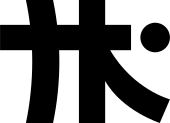

たかいですね
Learn the Japanese people actually speak.
From your first character to a real conversation — including the casual Japanese textbooks skip and everyone actually uses.
Both alphabets free. No card. No Japanese needed.
2,400+people learning with Tegaki
Inside Tegaki
The same sentence, five ways.
Every sentence Tegaki teaches says who you can use it with. Most courses teach the formal one and leave you to work out the rest alone.
“That’s expensive, isn’t it.”
- たかいですねPolitesay
- たかいですよねNatural politesay
- たかいねCasualsay
- たかいじゃんYouth casualhear
- たかText / slanghear
The words never change. Only the ending — and that decides who you are talking to. Three of these you learn to say. Two you only need to recognise.
Built the way people actually learn.
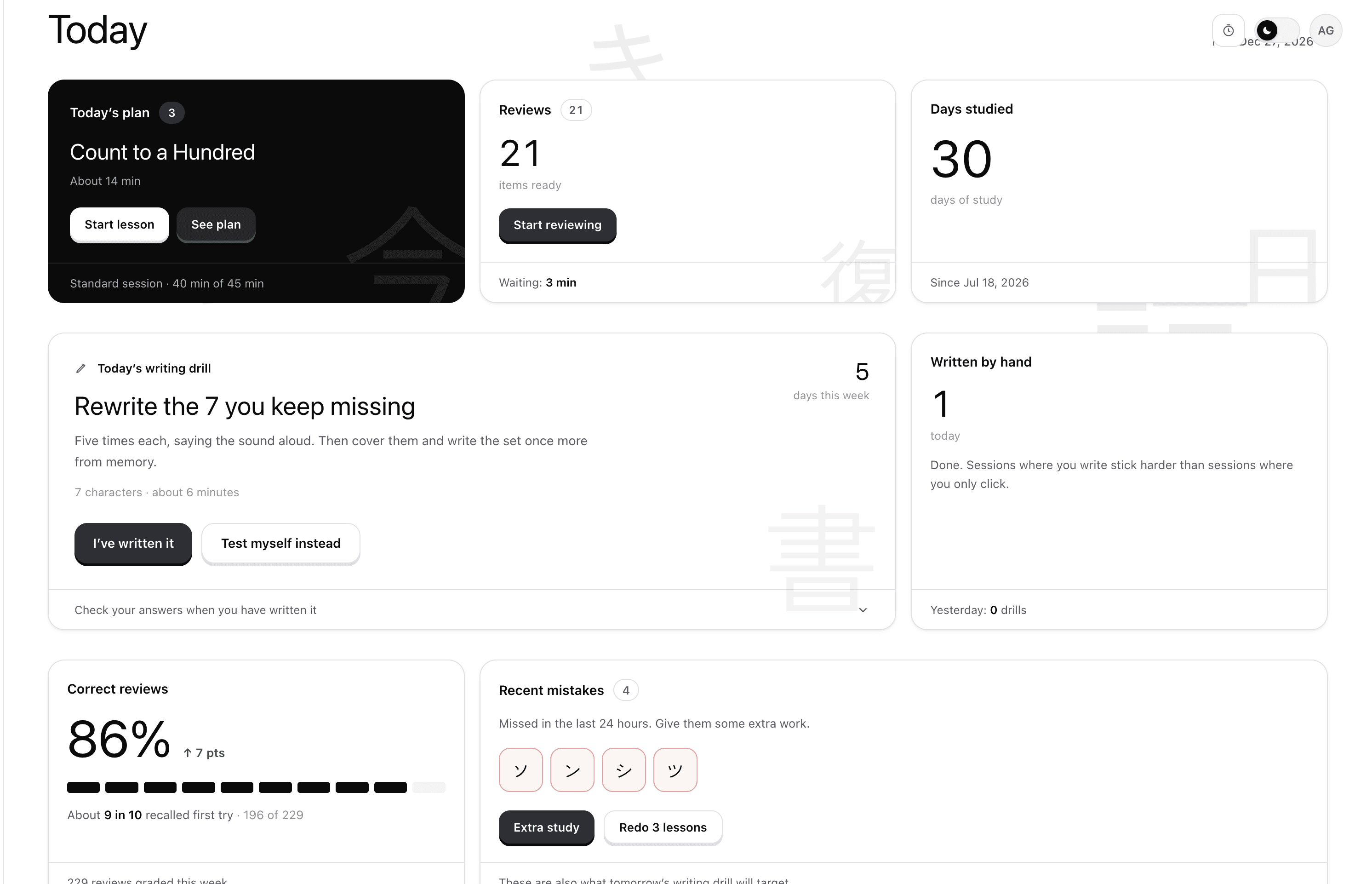
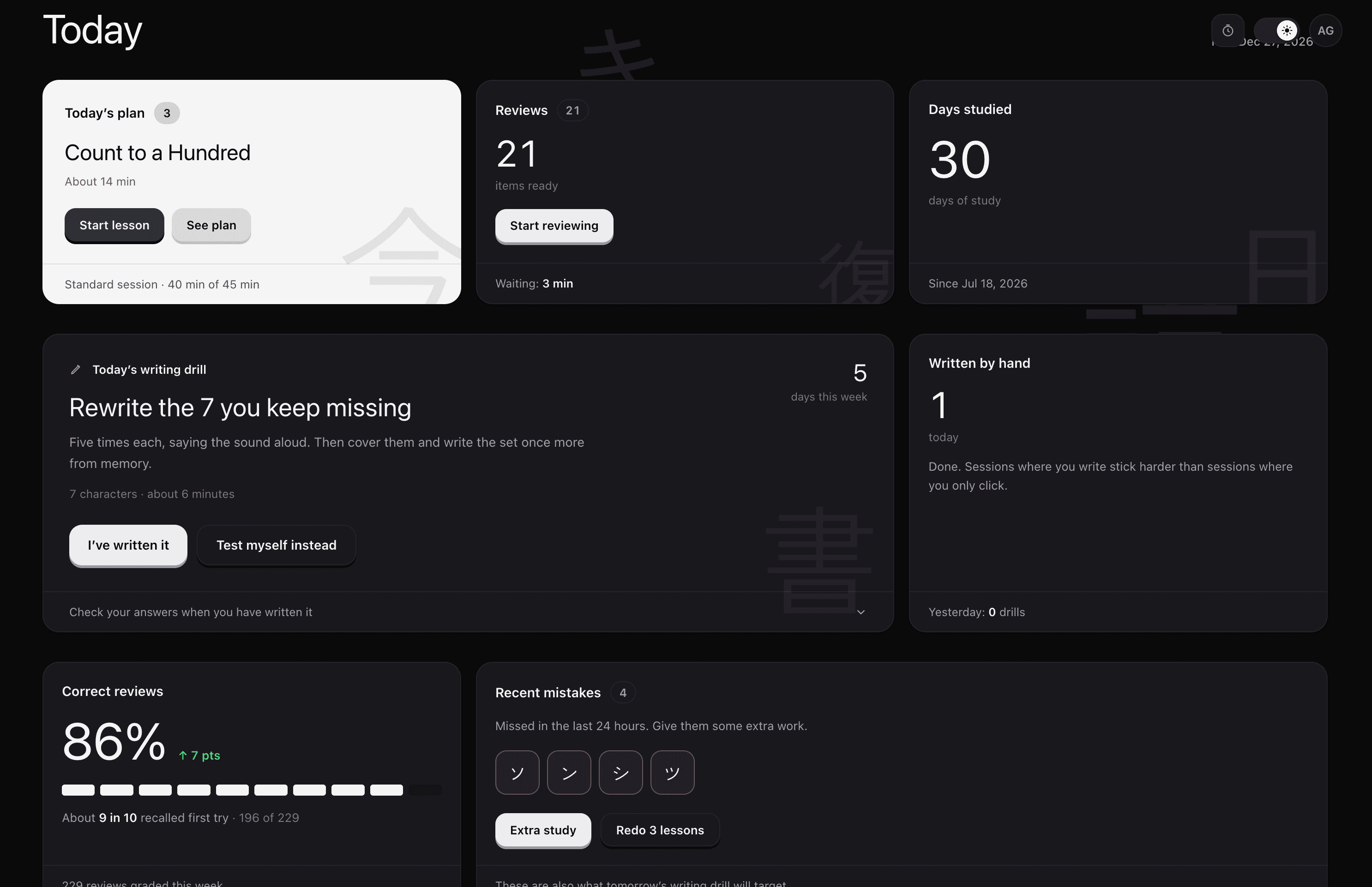
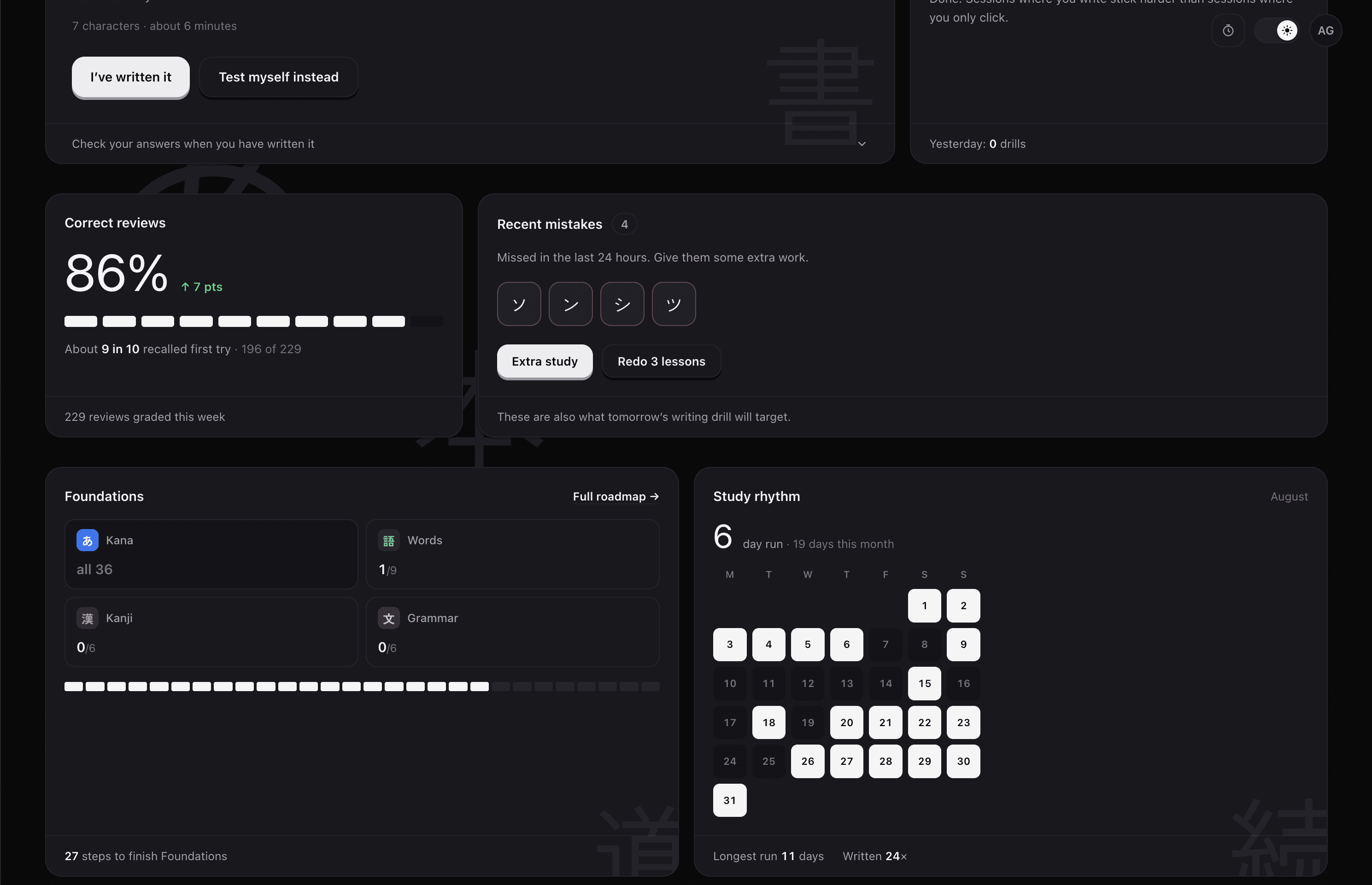
You write it by hand
One handwriting exercise a day — from a model, then from guides, then from memory. Recognising a character and being able to produce it are different skills.
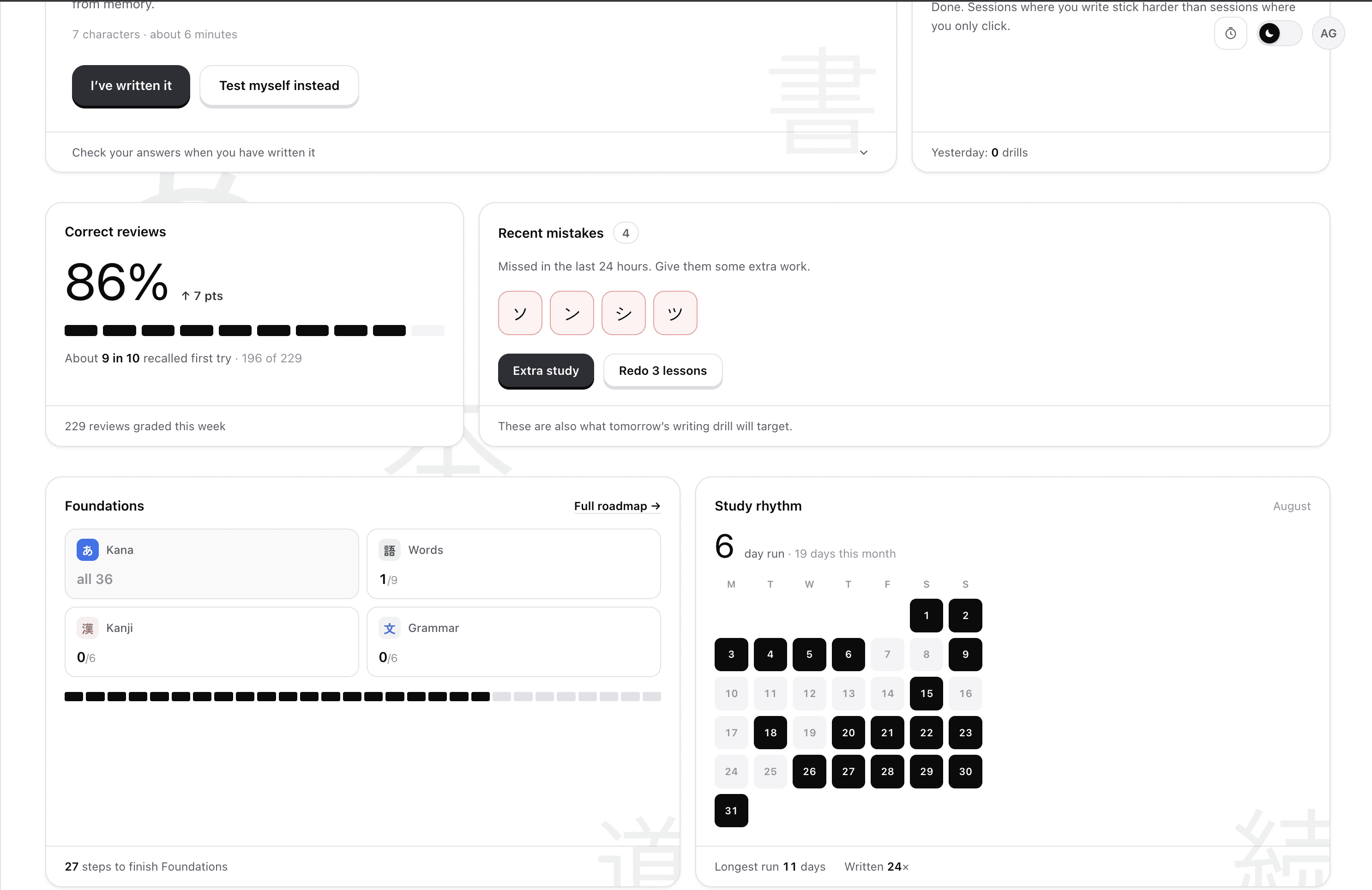
Nothing piles up
New material waits until the old has stuck. Miss a week and the plan changes, not the guilt. No streaks, no daily-goal shame.
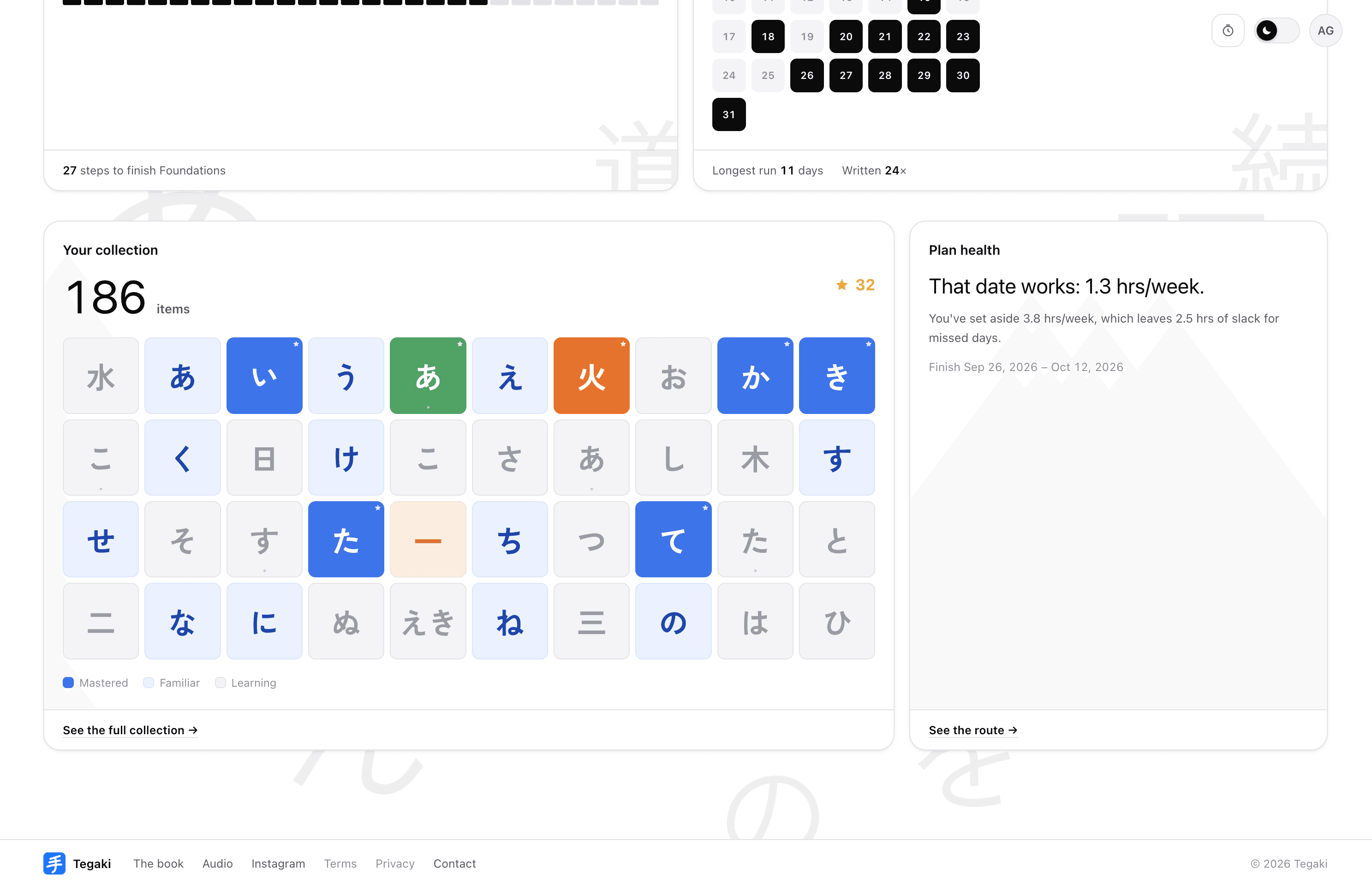
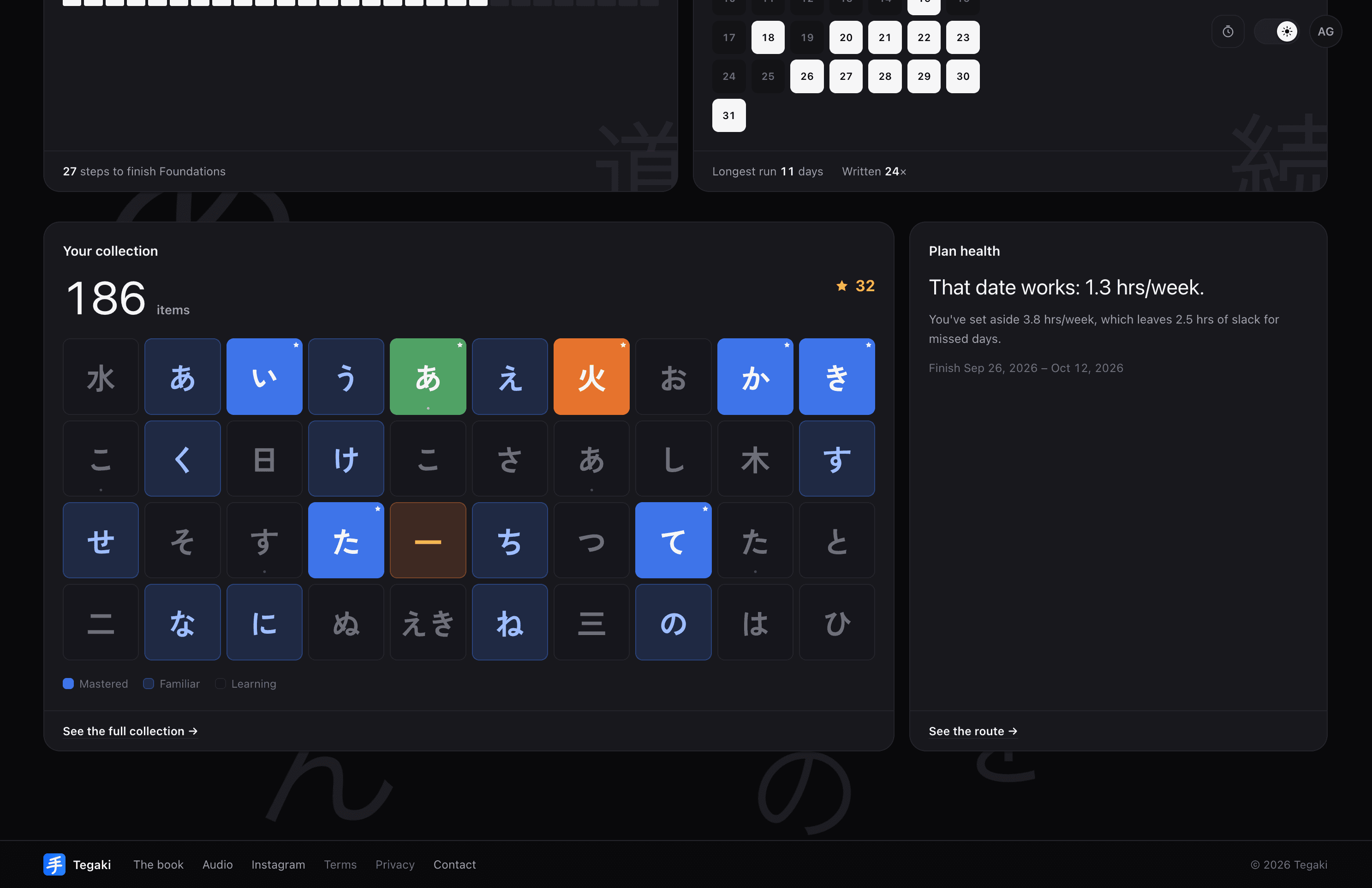
Everything you meet, you keep
Every character, word and pattern gets its own place — coloured by what it is, shaded by how well you know it. The honest version of a progress bar.
Four reasons people start.
The material barely differs. What differs is how the days are built — the rhythm, the drills, the emphasis. Nobody starts over when their reason changes.
What people say after a month.
“I did two years of an app and still froze when my girlfriend’s brother spoke to me. The register thing was the missing piece — I was speaking to everyone like a hotel receptionist.”
“The plan told me my exam date was not happening at four evenings a week. Annoying, correct, and the first time software has been straight with me about it.”
“Writing by hand felt like a chore for the first few days. Then I started noticing the characters everywhere without trying.”
“たかいじゃん. I have heard that a hundred times in anime and never once been taught it. That page alone was worth it.”
“No streak, no guilt, no notification telling me I have let it down. It just waits. I did not know how much I needed that until it was gone.”
“I told it twenty-five minutes because that is genuinely all I have focus for. It never once tried to talk me into more.”
“Reading how one person opens polite and the other slides into casual taught me more than any grammar table I have sat in front of.”
“My tutor asked where I learned to say it that way. Small thing. Felt enormous.”
FAQ
No. It starts at the first character — how it sounds, how to write it, and one real word you can read the moment you finish. If you already know some, a short placement finds where you actually are rather than making you start again.
Yes — properly. The exam route runs the whole ladder, N5 through N1, in the order the exam tests it. You get practice papers built to match the real thing section for section, and full mock exams you sit under time: at the end you get a scored result broken down the way the JLPT breaks it down, so you can see which section lost you the marks rather than just a number. Give Tegaki your exam date and it tells you honestly whether that date is reachable at the pace you set, and what would have to change if it is not.
However much you can give it with your full attention — that is the number Tegaki plans around. There is no session length you are supposed to hit. An hour you are genuinely focused for is worth more than three hours where you stopped concentrating after the first one, so you tell it what your honest daily window is and it builds the route to fit, rather than handing you a workload and hoping. Consistency is the part that does the work: the same window every day beats one long Sunday, because language lives in retrieval and retrieval has to repeat across days. Go at your own pace and do not overdo it.
Yes — there is a whole Resources section, and it is there in full from your first day rather than unlocking as you go. The full kana and kanji charts whether or not you have reached them, stroke-order guides, particle tables, verb and adjective conjugation, counters, a grammar index you can look up mid-sentence without losing your place, and JLPT word and kanji lists by level. And if you would rather study from a book, we publish one: Natural Japanese, a 434-page course on conversational Japanese. It is a separate product, not part of any plan.
Both kana alphabets are free — all 142 characters, hiragana and katakana, with the stroke order and the handwriting, and no card to start. Nothing counts down while you learn them; take as long as you want. Pro is $18 a month, or $144 a year, and it opens everything after kana: words, grammar, kanji, the register ladder and the exam route through to N1.
Nothing bad. New material is held back until the old material has stuck, so a week away means a week of review, not a backlog. There are no streaks to break and no notifications telling you off.
A kanji, a word, and something worth knowing.
Short, and actually about Japanese. No streak guilt, unsubscribe whenever.

Both alphabets, free.
- Free
- Read Japanese first. Decide after.
- Free
- Pro
- Everything after kana, all the way to N1.
- $18
No card to start. Cancel any time, and your progress waits for you.